Machines and the Realm of Equilibrium
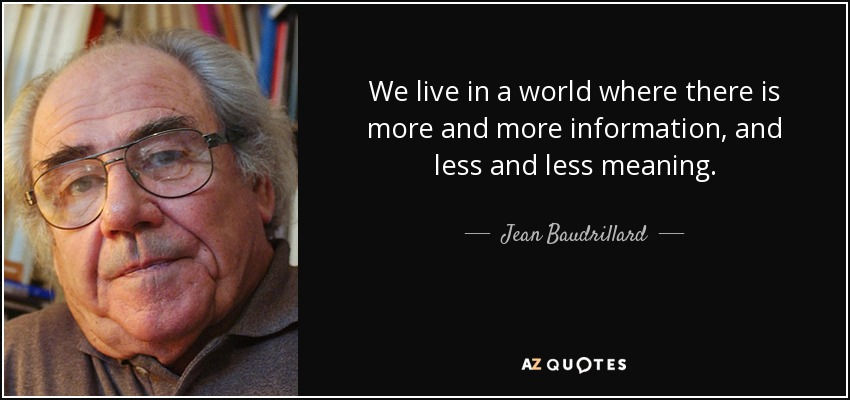
The theme of this week covers post-postmodernism which influences various theorists with an attempt to break the dichotomy of determinism or extremism in previous schools of thoughts. The first reading I touched on is Xerox and Infinity by Jean Baudrillard, a well-known French post-modernist theorist. This essay allows me to see a current phenomenon where the sense of reality is disappearing due to the fact that today technology (Telecomputer Man) is able to simulate reality—real intelligence is now simulated and Xeroxed into intelligent machines. Meaning of reality is somehow ambiguous. Those intelligent machines become, according to Baudrillard, prosthesis (artificial body part) for a species that has lost its ability of certain performance. For example, contact lenses and eyeglasses support people to gain back their eyesight; therefore, artificial intelligence become some sorts of hardware and mental prosthesis for men without the capacity for thought. On a different matter, visual reality in communication gives ambiguity to reality—now human can have sorts of passions via machines because all machines now can be tactile and exploratory. Proxemics of images; promiscuity of image; tactile pornography of images. The paradigm of sensory has changed to become something on a screen, the screen that can transfer sensory signal though human and human in distance. All I have mentioned makes an implication that post-modern reality is disappearing, as I suppose. Where is the reality of reality?
Next let me draw a direct interesting quote. Baudrillard writes [p.g.53], “There are prostheses that can work better than humans, think or move around better than humans…That is why man can always be more than he is.” I can understand that in some cases human can produce a thing which is more real than real [hyperreality], with support by artificial prostheses. For instances, people, who are considered physical cripples, can sit teleconference in distance; it produces something more real than human’s real ability. It was more unreal to have a group of people in different parts of the world to sit in a conference, but post-modern artificial machines allow human to go beyond reality—they can do more than they really can do. Human can performance better and think better with those machines. Moreover, the quote above depicts the fact that [artificial] machines have extraordinary ability to create a new man; with machines a man can invent himself into somebody else. A simple example can be seen in the creation of computer software by Bill Gates who enjoyed the spectacle of his own brain, own intelligence. Machines made by Gates eventually created many other computer genius persons.
To end my comment on Jean Baudrillard’s Xerox and Infinity, I am impressed by how Baudrillard’s work differs from previous grand theories, particularly Marxism, alienation. It is interesting to see that machines are now perceived as human’s subordinate limbs rather than alienation as Marx argued. No longer being trapped within two extreme dichotomy of otherness and alienation, post-modern society is a realm of interfaces and interactivity. Extreme idea that human are alienated by machine no longer exists, and people stop asking whether they are free or alienated, whereas now machines are considered as genetic parts of human beings which allows them to perform a certain function which they naturally cannot do. In reality a man with limb disability could move properly as normal men do. Yet artificial machines can get all men to the realm of equilibrium where disable men can walk normally and short-sighted man can read as normal people do.
Finally I just want to ask you guys a question. Why do we need to be extreme? Is extremism able to help you out of total control of a superpower? Rather than being extreme, why don't we use the advantage from superpower to develop ourselves in the same way that we use machines?
Further reading about Jean Baudrillard at: https://drive.google.com/drive/u/0/folders/0B6mvKM8_UsFqSnlGTlFnWVhDcGc


Comments